
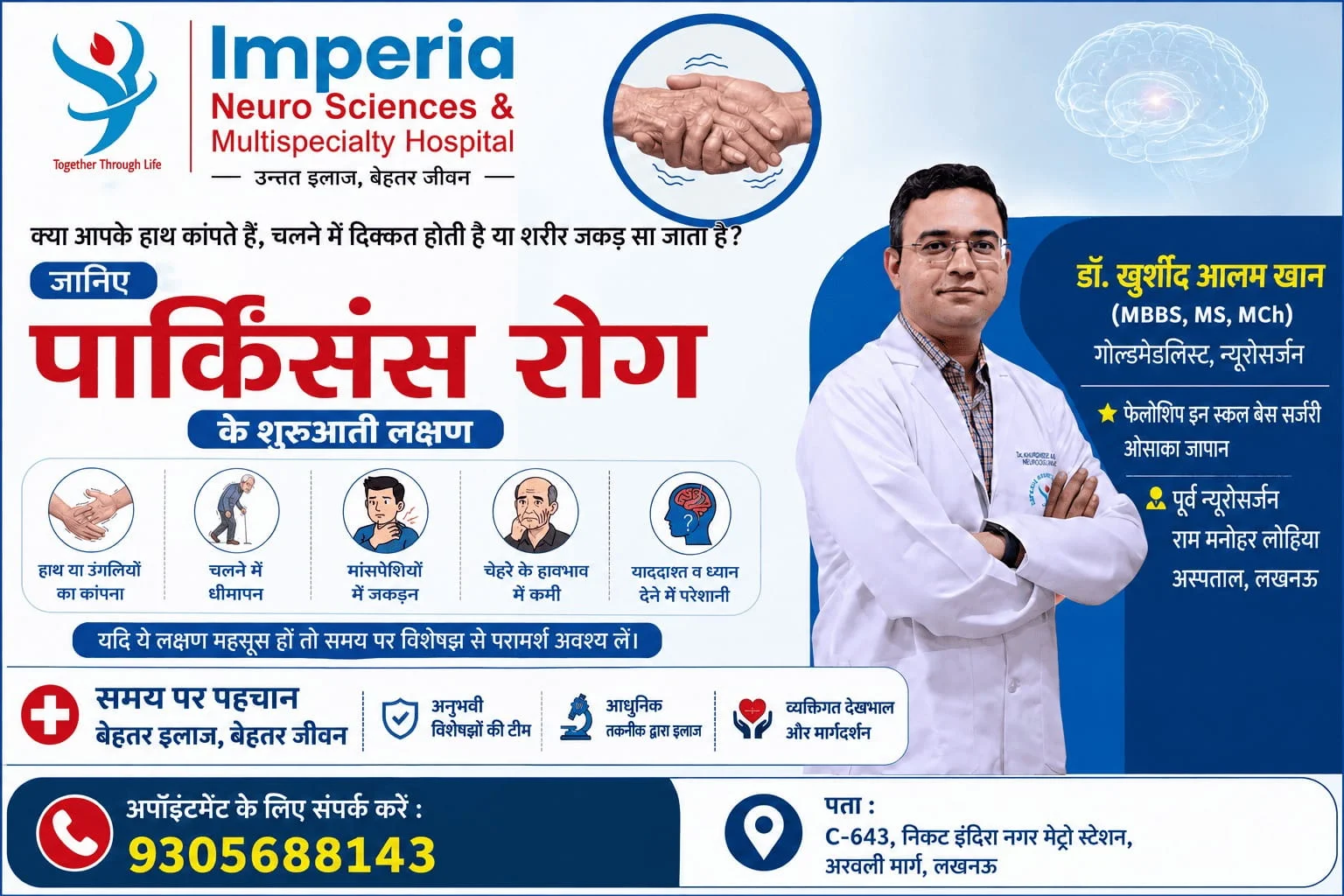
Parkinson's Disease: 10 Early Symptoms You Should Not Ignore
Parkinson’s disease is a progressive neurological disorder that mainly affects movement. The symptoms often develop gradually and may be mild during the early stages. Recognizing Parkinson’s disease early symptoms can help patients and their families seek timely medical evaluation.
At Imperia Neuro Sciences & Multispeciality Hospital, Lucknow, patients can consult experienced specialists for neurological concerns and access comprehensive neuro care. The hospital provides services related to brain, spine and neurological conditions along with advanced diagnostic, critical care and rehabilitation support.
What Is Parkinson’s Disease?
Parkinson’s disease is a disorder of the nervous system that affects movement. It is associated with changes in certain brain cells involved in dopamine production. Dopamine is an important chemical messenger that helps control smooth and coordinated movement.
As the condition develops, a person may experience symptoms such as tremors, slowness of movement, muscle stiffness and difficulties with balance.
The symptoms and progression of Parkinson’s disease can vary from person to person.
What Are the Early Symptoms of Parkinson’s Disease?
The early signs of Parkinson’s disease may be subtle and can gradually become more noticeable. Some common symptoms include the following.
1. Tremor or Shaking
Tremor is one of the most commonly recognized symptoms of Parkinson’s disease.
It may begin in:
One hand
Fingers or thumb
Arm
Leg
The tremor may be more noticeable when the affected part of the body is at rest.
However, it is important to remember that not every person with Parkinson’s disease experiences tremors, and tremors can also occur because of other medical conditions.
2. Slow Movement
Slow movement, medically known as bradykinesia, is another important symptom of Parkinson’s disease.
A person may gradually notice that everyday activities take more time and effort.
This may include difficulty with:
Getting up from a chair
Walking
Turning around
Dressing
Buttoning clothes
Performing routine hand movements
Movements may also become smaller and less automatic.
3. Muscle Stiffness
Muscle stiffness or rigidity can affect different parts of the body, including the arms, legs, neck and trunk.
The stiffness may:
Make movement more difficult
Reduce the range of motion
Cause discomfort
Affect normal daily activities
Persistent stiffness should not always be assumed to be a normal part of ageing.
4. Changes in Walking
Changes in walking may also be among the Parkinson’s disease early symptoms.
A person may experience:
Shorter steps
Shuffling while walking
Difficulty starting to walk
Reduced arm movement while walking
Difficulty turning
In some cases, a person may temporarily feel as though their feet are difficult to move. This can be described as freezing of gait.
5. Balance and Posture Changes
Parkinson’s disease can affect posture and balance.
Some people may gradually notice:
Difficulty maintaining balance
Feeling less stable while walking
Stooped posture
Difficulty turning
Significant or repeated balance problems should be evaluated by a healthcare professional.
6. Smaller Handwriting
A noticeable change in handwriting can occur in some people with Parkinson’s disease.
The handwriting may become:
Smaller
More crowded
More difficult to read
This type of unusually small handwriting is sometimes called micrographia.
If a persistent change in handwriting occurs along with other movement-related symptoms, it may be worth discussing with a doctor.
7. Changes in Speech
Parkinson’s disease can also affect the muscles involved in speech.
A person may notice that their voice becomes:
Softer
Quieter
More monotone
Less clear
Speech changes can occur for many different reasons, but persistent changes should be medically assessed.
8. Reduced Facial Expressions
Some people with Parkinson’s disease may have less facial movement than usual.
Family members may notice:
Reduced facial expressions
Less frequent blinking
A face that appears less expressive
This can happen because the condition affects movement.
9. Sleep Problems
Sleep disturbances may occur in people with Parkinson’s disease.
Possible sleep-related concerns include:
Difficulty sleeping
Frequent waking during the night
Excessive daytime sleepiness
Unusual movements during sleep
Sleep problems alone do not mean that a person has Parkinson’s disease because they can have many different causes.
10. Reduced Sense of Smell
Some people may experience a reduced ability to smell, known as hyposmia.
A persistent change in the sense of smell may occur before some of the more noticeable movement symptoms in certain individuals.
However, reduced smell can also result from other causes and cannot diagnose Parkinson’s disease on its own.
Other Possible Early Signs of Parkinson’s Disease
Parkinson’s disease can involve symptoms beyond movement problems. Some people may also experience changes such as:
Constipation
Fatigue
Sleep disturbances
Mood changes
Anxiety or depression
Having one or more of these symptoms does not necessarily mean that a person has Parkinson’s disease.
A proper medical evaluation is important to identify the actual cause.
https://www.ninds.nih.gov/health-information/disorders/parkinsons-disease
What Causes Parkinson’s Disease?
The exact cause of Parkinson’s disease is not fully understood.
Research suggests that a combination of factors may contribute, including:
Changes in certain brain cells
Genetic factors in some cases
Environmental factors
Parkinson’s disease is associated with the loss or dysfunction of brain cells involved in producing dopamine.
Research into the causes and treatment of Parkinson’s disease is ongoing.
How Is Parkinson’s Disease Diagnosed?
There is no single test that confirms every case of Parkinson’s disease.
A healthcare professional generally evaluates:
Medical history
Current symptoms
Tremor
Slowness of movement
Muscle stiffness
Walking pattern
Balance
Other neurological signs
Additional tests may sometimes be recommended to rule out other conditions that can produce similar symptoms.
A neurological evaluation is important when symptoms suggest a possible movement disorder.
When Should You See a Neurologist?
You should consider consulting a doctor if you experience persistent or gradually worsening symptoms such as:
Tremors
Slow movement
Unexplained muscle stiffness
Changes in walking
Difficulty with balance
Persistent changes in handwriting
Speech changes
For neurological symptoms requiring evaluation, patients can seek specialist consultation through the Neurology and Neuro Sciences services at Imperia Neuro Sciences & MultiSpeciality Hospital in Lucknow. The hospital also offers comprehensive brain and spine care, critical care, diagnostic services and rehabilitation-related support.
Can Parkinson’s Disease Be Treated?
Although there is currently no cure for Parkinson’s disease, treatment options can help manage symptoms and support quality of life.
Depending on an individual’s condition, management may include:
Medications
Physical therapy
Regular exercise programmes
Occupational therapy
Speech and language therapy
Rehabilitation support
Other specialist treatments when medically appropriate
The treatment plan should always be individualized by a qualified healthcare professional.
Parkinson’s Disease Treatment and Neurological Care in Lucknow
Timely evaluation of persistent neurological symptoms can help determine their cause and guide appropriate treatment.
Imperia Neuro Sciences & Multispeciality Hospital provides neuro-focused and multispeciality healthcare services in Lucknow. Its website lists Neurology, Neurosurgery, Neuro Sciences and Neuro-Regeneration & Rehabilitation among its neurological departments and services, with additional emergency, ICU and diagnostic facilities.
The hospital is located at C-643, Aravali Marg, Near Indira Nagar Metro Station, Indira Nagar, Lucknow, Uttar Pradesh 226016.
Frequently Asked Questions About Parkinson’s Disease
What are the first symptoms of Parkinson’s disease?
Early symptoms may include tremor, slow movement, muscle stiffness, changes in walking, smaller handwriting and changes in speech. Symptoms can vary between individuals.
Does everyone with Parkinson’s disease have tremors?
No. Tremor is a common symptom, but not every person with Parkinson’s disease develops a tremor.
Can Parkinson’s disease cause walking problems?
Yes. Parkinson’s disease can affect movement and may cause short steps, shuffling, difficulty turning or problems initiating movement.
Is Parkinson’s disease curable?
There is currently no cure, but treatment can help manage symptoms and support quality of life.
When should I consult a neurologist for Parkinson’s symptoms?
You should seek medical advice if you have persistent or worsening tremors, slow movement, stiffness, walking changes, balance problems or other unusual neurological symptoms.
Can Parkinson’s disease occur at a young age?
Parkinson’s disease is more common in older adults, but younger-onset cases can also occur.
Conclusion
Recognizing Parkinson’s disease early symptoms can help individuals pay attention to important changes in movement and neurological health.
Symptoms such as tremors, slow movement, muscle stiffness, walking changes, smaller handwriting and speech changes should not be ignored when they are persistent or gradually worsening.
These symptoms can have causes other than Parkinson’s disease, so self-diagnosis should be avoided. A proper evaluation by a qualified healthcare professional is important for identifying the cause and determining the appropriate next steps.